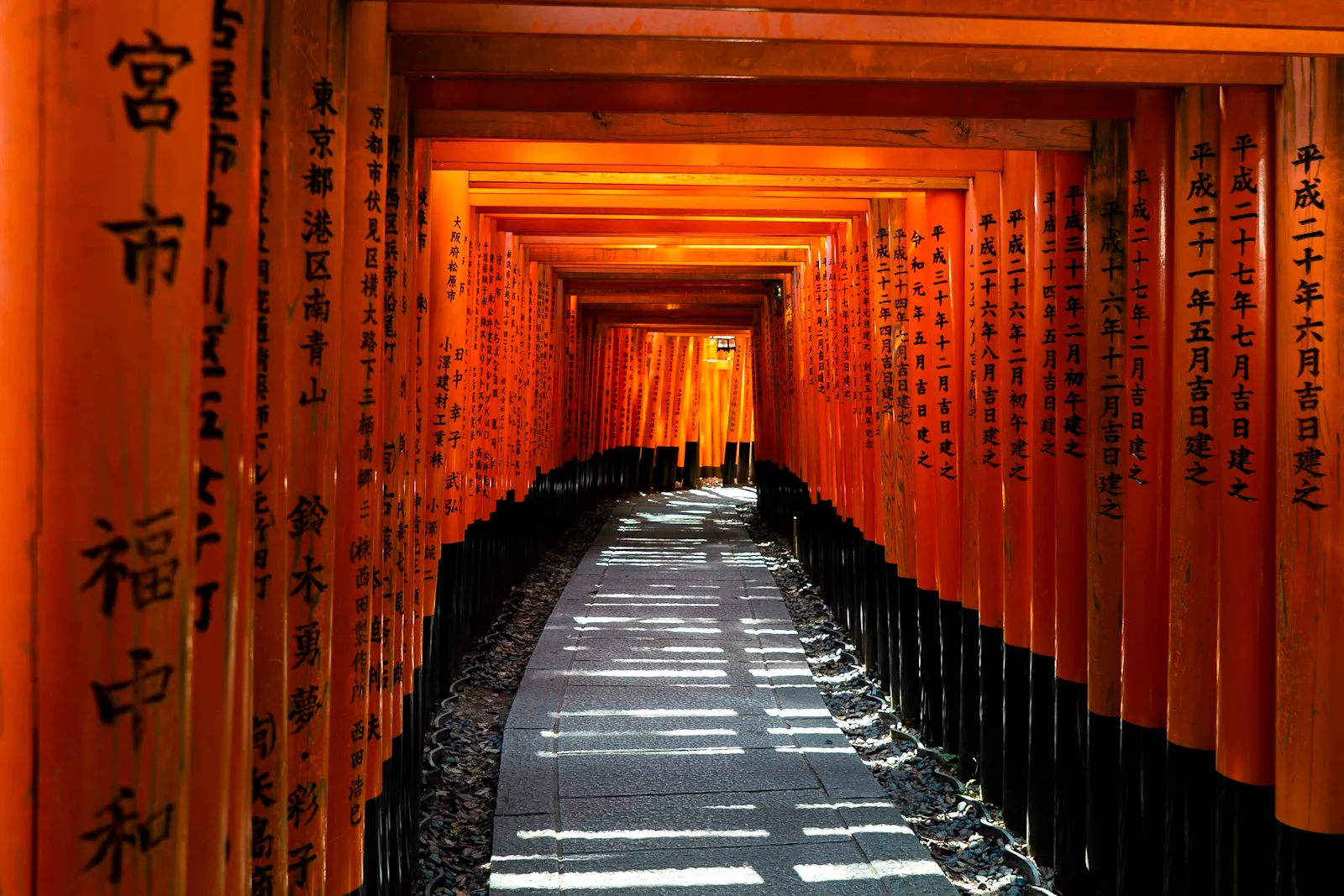
Thousands of vermilion torii gates winding up a forested mountain — Fushimi Inari is the head shrine of Japan’s 30,000 Inari shrines and the most visited spot in Kyoto. It is free, open 24 hours, and only two stops from Kyoto Station, which is exactly why it is packed from 9:00 to 16:00. Seeing just the famous Senbon Torii takes 30 minutes; a full loop of Mt Inari takes 2–3 hours. This guide covers access, the three route options, and the hours when the gates are actually empty.
Quick facts
| Item | Details |
|---|---|
| Admission | Free |
| Hours | Open 24 hours (shrine office about 7:00–18:00) |
| Closed | Never |
| Time needed | 30–40 min to the Senbon Torii, 1.5 h return to Yotsutsuji, 2–3 h for the summit loop |
| Address | 68 Fukakusa Yabunouchi-cho, Fushimi-ku, Kyoto |
| Official site | inari.jp |
How to get to Fushimi Inari from Kyoto Station
- JR Nara Line from Kyoto Station to Inari Station: 2 stops, about 5 minutes, ¥150. The main gate is directly in front of the station. Take a local train — rapid trains skip Inari.
- Keihan Line to Fushimi-Inari Station, then a 5-minute walk. Use this from Kiyomizu-dera (Kiyomizu-Gojo) or Gion (Gion-Shijo).
- City Bus South 5 from Kyoto Station to Inari Taisha-mae, about 20 minutes. The train is faster and more reliable.
The three route options
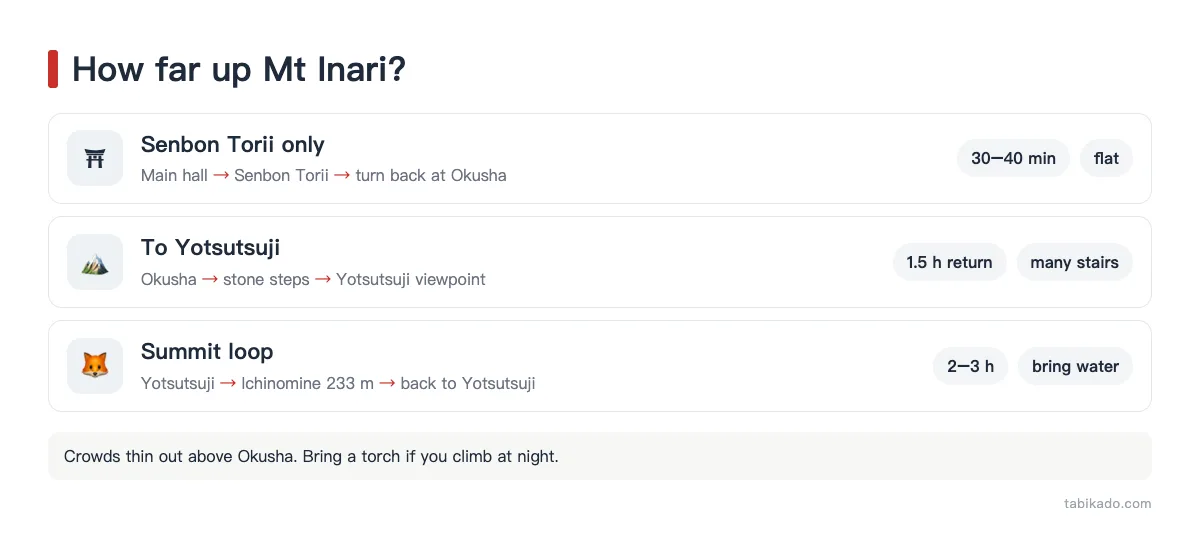
Past the main hall you enter Mt Inari. Decide how far you want to go before you start.
- Senbon Torii only (30–40 min): Main hall → Senbon Torii (the section where the path splits into two parallel tunnels of gates) → Okusha Hohaisho, with the “heavy-light stones”. Most visitors turn around here.
- To Yotsutsuji (1.5 h return): Continue up the stone steps from Okusha to the Yotsutsuji crossroads, a viewpoint over southern Kyoto with a couple of tea houses. The crowds thin out dramatically above Okusha.
- Summit loop (2–3 h): From Yotsutsuji, a loop over the summit Ichinomine (233 m) and back. The gates never stop, and you pass dozens of small sub-shrines and fox statues. At night the upper path has few lights, so bring a torch.
There are a lot of stairs. For the summit, wear proper shoes and carry water; vending machines are sparse above Yotsutsuji.
When the gates are empty
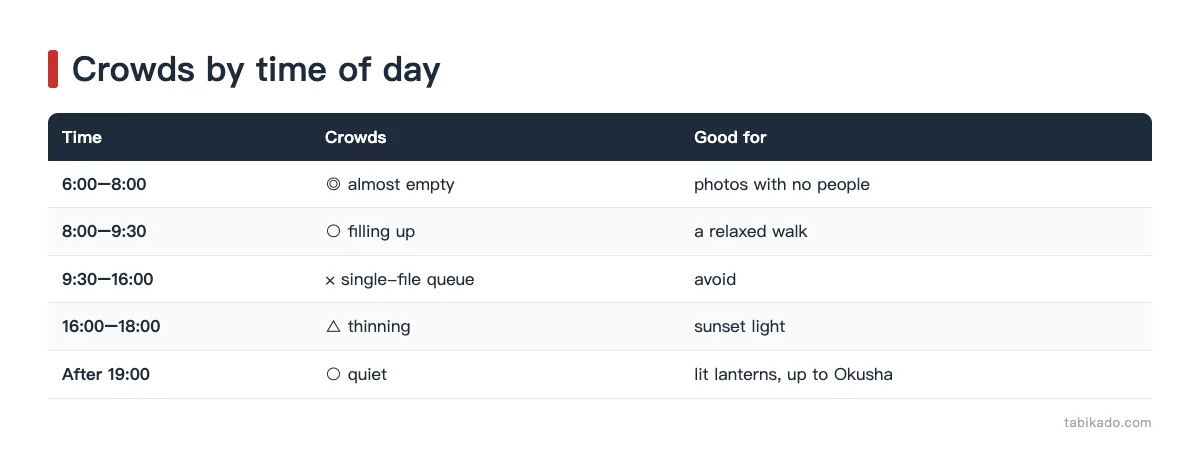
- Early morning (6:00–8:00): the only time you can photograph the torii with nobody in them. Just after sunrise is best.
- Evening (after 19:00): the lanterns are lit and the crowds are gone. The path to Okusha is safe in the dark.
- Avoid: 9:30–16:00, especially weekends and holidays, when the gates become a single-file queue.
Half-day plan: Fushimi Inari and the Fushimi sake district
- 7:00 Fushimi Inari (Senbon Torii to Yotsutsuji)
- 9:30 Street food on the approach: inari-zushi, grilled sparrow and quail skewers
- 10:30 Keihan Line to Chushojima for the Fushimi sake breweries (Gekkeikan Okura Sake Museum, ¥600)
- 12:30 Lunch, then Keihan to Gion-Shijo for an afternoon in Gion and Kiyomizu-dera
[Affiliate slot: Fushimi Inari early-morning guided walk — Klook / KKday]
Tips
- Small coin lockers exist at the station and on the approach, but they fill up. Leave luggage at Kyoto Station.
- Heavy-light stones (omokaru-ishi): make a wish at Okusha, lift the stone lantern’s cap — if it feels lighter than expected, the wish will come true.
- The writing on the back of each gate is the name and date of the company or person who donated it.
- Because it is 5 minutes from Kyoto Station and open 24 hours, it fits easily on your arrival evening or departure morning.
Nearby
- Kiyomizu-dera — Keihan to Kiyomizu-Gojo, 15 min + walk
- Gion — Keihan to Gion-Shijo, 10 min
- Nara — JR Nara Line from Inari, about 1 hour
See also the full list of things to do in Kyoto, the 3-day Kyoto itinerary and Kansai Airport to Kyoto.
Official information: Fushimi Inari Taisha · Kyoto City Official Travel Guide · Google Maps
Comments